
Best Phonics Class in Bahrain: How to Choose a Program That Actually Builds Reading Skills
If you're a parent in Manama, Riffa, or Muharraq searching for the Best Phonics Class in Bahrain, you've probably noticed something frustrating: almost every website says the same thing. "Expert teachers." "Fun learning." "Proven results." None of it tells you what actually makes a phonics program work.
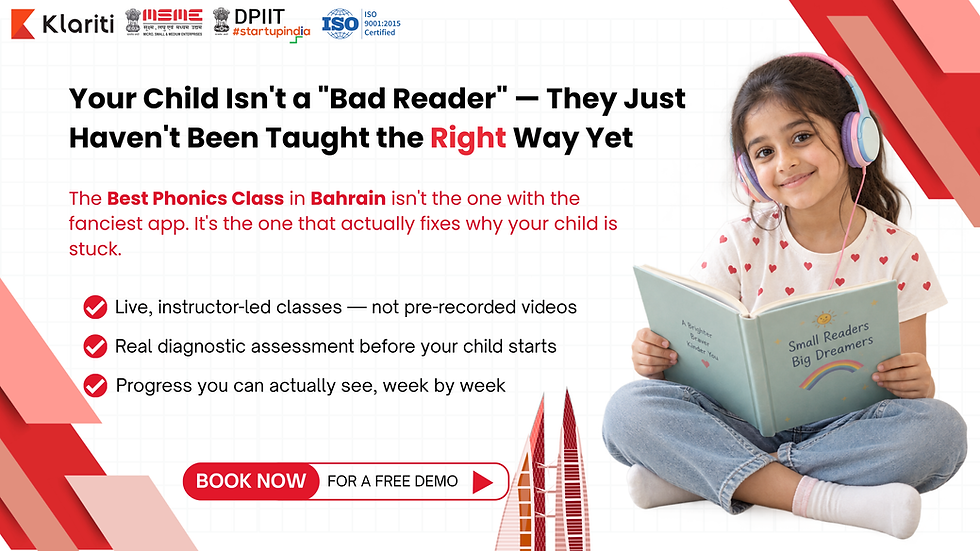
This guide breaks that pattern. We'll walk through what genuinely effective phonics instruction looks like, the mistakes most programs make, and why Klariti Learning has become a trusted name for parents across the Gulf region who want their child to read with confidence — not just recognize letters.
What Makes the Best Phonics Class in Bahrain Different From a Generic Reading Program
Phonics is often treated as a single subject. In reality, it's a layered skill built from five components: phonemic awareness, letter-sound correspondence, blending, decoding, and fluency. A program that skips any one of these produces a child who can "read" out loud but struggles to comprehend what they've read.
This is the gap most families run into. A class might teach a child to sound out words mechanically, but without decoding strategy and fluency practice, that skill doesn't transfer to real books, real homework, or real confidence at school.
At Klariti Learning, phonics instruction is sequenced deliberately — each session builds on phonemic awareness before introducing blends, digraphs, and sight-word exceptions. This structure mirrors how literacy researchers describe the "science of reading," a framework increasingly referenced by education systems worldwide, including guidance published by Reading Rockets and literacy research from the Yale Center for Dyslexia & Creativity.
Why Parents in Bahrain Are Choosing Online Phonics Classes Over Local Tuition Centers
Bahrain's expat and local families share a common challenge: finding a phonics tutor whose schedule, teaching style, and curriculum quality actually fit a working household. Traditional tuition centers are convenient geographically, but they're often generic — one curriculum applied to every child regardless of reading level.
Online phonics classes have closed that gap by offering:
Live, instructor-led sessions instead of pre-recorded content
Small group or one-on-one formats so pacing matches the child, not the average of the class
Flexible scheduling across Gulf Standard Time without commute time
Parent visibility into what's being taught each week
This is precisely why searches for the best phonics class in Bahrain increasingly return online-first providers rather than only local centers — the format itself solves a logistics problem that geography-bound classes can't.
What Separates a True Phonics Expert From a Class That Just "Teaches Reading"
Here's the distinction most parents don't realize until after they've enrolled: theoretical knowledge of phonics rules is not the same as practical classroom expertise.
A person who knows the rules of English phonics can explain what a digraph is. A person with practical expertise knows what to do in the moment when a five-year-old confidently reads "b" as "d," or when a seven-year-old can decode single words but freezes on connected text.
Theoretical Knowledge | Practical Classroom Expertise |
Knows phonics rules and terminology | Recognizes why a specific child is stuck and adjusts in real time |
Follows a fixed lesson plan | Adapts pacing based on live reading behavior |
Measures progress by lesson completion | Measures progress by decoding accuracy and fluency growth |
Treats every learner the same | Builds around individual reading gaps (reversals, blending delays, sight-word memory) |
This is the difference between a curriculum being delivered and a curriculum being taught. The best phonics class in Bahrain — or anywhere — is run by instructors who've spent real hours diagnosing why a specific child is stuck, not just following a script.
The Klariti Learning Approach: Built From Real Classroom Experience, Not a Template
Klariti Learning was founded by Sangeetha Ramasamy, whose approach to early literacy grew out of direct classroom experience rather than a franchised curriculum bought off the shelf. That distinction shapes how the program is structured today.
Rather than a one-size-fits-all workbook, Klariti's phonics program is built around:
1. Diagnostic-first placement
Before a child starts, instructors assess where their specific reading gaps are — blending, letter reversal, sight-word recall, or fluency — so the class starts at the right level instead of a default starting point.
2. Live, small-group instruction
Sessions are conducted live, allowing instructors to catch and correct reading errors as they happen, not after a worksheet is submitted.
3. Progress that parents can actually see
Parents receive visibility into what's being taught and how their child is progressing, rather than a vague "great job" update.
4. Instruction built for global English learners
Because Klariti teaches children across India, the Gulf, and other international markets, the curriculum is designed to work for children learning English as an additional language — a common scenario among Bahrain's diverse resident population.
This is also reflected in how Klariti approaches content and search visibility itself: the brand's phonics content has been surfaced directly inside Google's AI Overview results for related search queries — a signal search engines use to indicate topical trust, not just page ranking.
Common Questions Parents Ask Before Choosing a Phonics Class in Bahrain
At what age should a child start phonics classes?
Most literacy specialists recommend starting formal phonics instruction between ages 4 and 6, once a child shows basic letter recognition and can identify beginning sounds in words.
How is an online phonics class different from in-person tuition?
An online phonics class run by a live instructor offers the same real-time correction and interaction as in-person tuition, with the added benefit of flexible scheduling and no commute — an important factor for busy families in Bahrain.
How long does it take to see results from phonics classes?
With consistent weekly sessions, most children show noticeable improvement in blending and decoding within 8 to 12 weeks, though fluency gains typically build over a longer period.
Is phonics necessary if a child already recognizes some words?
Yes. Recognizing whole words by sight (sight-reading) is not the same as being able to decode unfamiliar words. Phonics gives children the tool to read words they've never seen before, which sight-reading alone cannot do.
What should parents look for in the best phonics class in Bahrain?
Look for live instruction (not pre-recorded videos), a diagnostic starting assessment, small class sizes, and visible progress tracking — not just marketing claims about "fun learning."
Choosing the Right Fit for Your Child
There's no single answer to which phonics class is "best" in the abstract — the right choice depends on your child's current reading stage, your schedule, and how much individual attention they need. What matters is asking the right questions before you enroll: Is instruction live? Is there a real diagnostic starting point? Can you see actual progress, not just attendance?
If you'd like to see how Klariti Learning's phonics program is structured for your child's specific reading level, you're welcome to explore a session and judge the approach for yourself — no pressure, just a clearer picture of what real phonics instruction looks like.
Link "all-courses" section → https://www.klaritilearning.com/all-courses
Link founder mention → an " / Our Story" page, if available
Reading Rockets (literacy research): https://www.readingrockets.org/
Yale Center for Dyslexia & Creativity: https://dyslexia.yale.edu/
British Council – Learning English guidance (for ESL-relevant families): https://learnenglishkids.britishcouncil.org/


Comments